



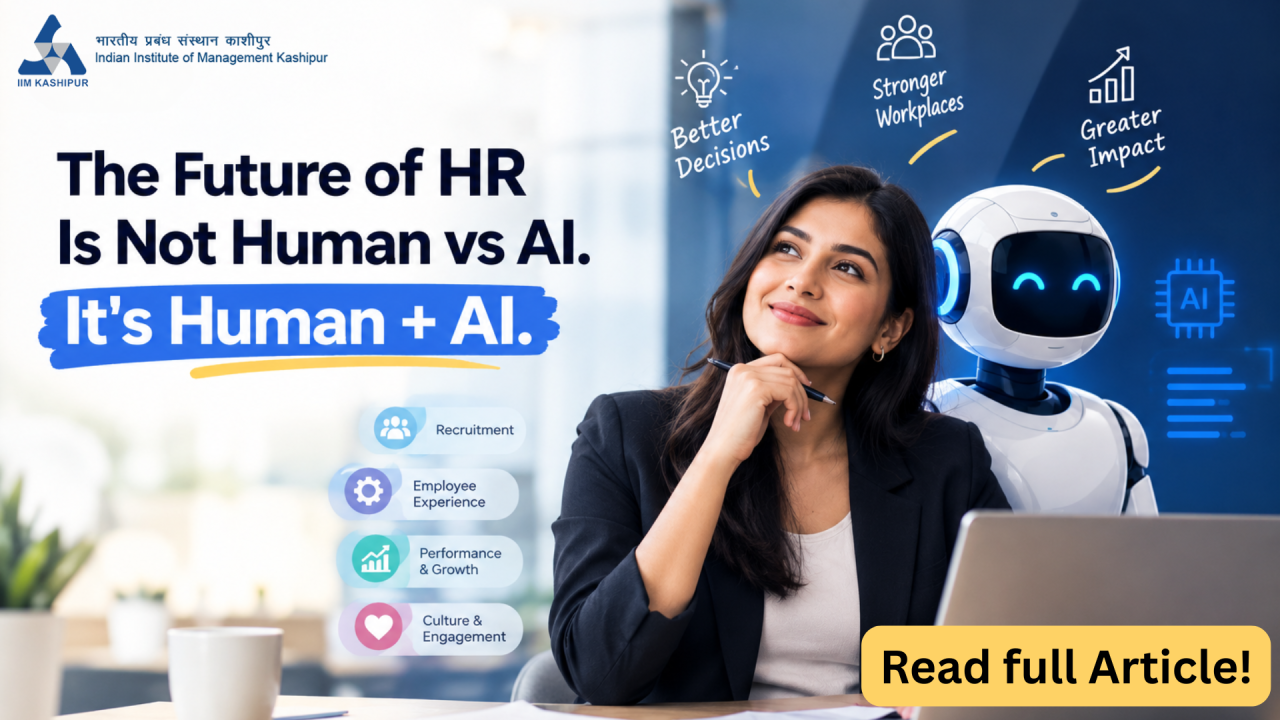
Every time AI makes a leap forward, someone in HR starts wondering if their job is next. It's an understandable fear, and also the wrong question. AI isn't coming to replace HR judgment — it's coming to sharpen it. The HR professionals who thrive over the next decade won't be the ones competing with AI. They'll be the ones who've learned to combine it with the one thing AI still can't replicate: genuine human understanding.
This isn't a hypothetical debate happening somewhere off in the future. AI is already sitting inside recruitment platforms, engagement surveys, and workforce planning tools right now, quietly changing how HR decisions get made — which makes the "Human vs AI" framing not just wrong, but genuinely out of date. The question worth asking isn't whether AI belongs in HR. It's whether HR professionals are building the skills to work alongside it well.
Why "Human vs AI" Is the Wrong Question
HR has always been a judgment-heavy function — reading a candidate beyond their resume, sensing team morale before it shows up in an exit interview, knowing which policy will land well and which will trigger backlash. AI sitting in the room doesn't remove any of that judgment. What it changes is everything that has to happen before the judgment gets applied.
In recruitment, AI can already screen resumes at a scale no team could match by hand, surface candidates a keyword search would have overlooked, and flag bias buried in a job description before it ever goes live. Deciding who's actually the right fit for the team, though, still takes a person in the room. In employee engagement, AI-powered pulse surveys and sentiment analysis can catch disengagement spreading across thousands of employees at once — something no single manager could track manually. Figuring out what those signals actually mean for one specific team, and what to do about it, still takes empathy no model has. Workforce planning now runs on AI models that can flag a skill gap or attrition risk months before it becomes a crisis, and performance and retention data can surface a flight risk long before someone hands in their notice.
The thread running through all of it is simple: AI expands what HR can see. It's still a human being who decides what to do with that view. It's Human + AI — not one replacing the other, but each covering exactly where the other falls short.
AI adoption among HR professionals surged to 72% in 2025, up from 58% in 2024, according to HireVue's Global Guide to AI in Hiring — a clear signal that AI in HR has moved from experimentation to standard practice, faster than most functions have managed to adapt around.
The Bigger Shift: From Gut Feel to Evidence
Most HR teams still run on instinct — a manager's hunch about who's about to quit, a rough guess at next year's headcount. That worked fine when business moved slowly enough for instinct to keep up. It doesn't anymore, and AI is what's finally giving that instinct something to check itself against.
Strategic workforce planning built on real data changes the decision itself — modeling skill gaps before they open, forecasting headcount against actual trends, and catching a morale problem while it's still small instead of after it shows up in exit interviews. This is what evidence-based HR looks like in practice: not data replacing judgment, but judgment finally getting something solid to stand on. And it's why HR professionals who make this shift stop being seen as administrative and start being treated as strategic.
Where Most HR Professionals Actually Get Stuck
Here's the uncomfortable part: almost everyone in HR agrees this shift is happening. Very few have had the chance to actually build the skills it demands — the gap between knowing a dashboard exists and knowing how to build one, between hearing predictive analytics is useful and applying it to a real attrition problem sitting on your desk.
This is the exact gap IIM Kashipur's Executive Development Programme in Strategic HR Analytics & AI was built to close — and it's built around the same Human + AI idea running through this entire piece: pairing genuine data fluency with the human judgment AI still can't replace. For anyone looking at Strategic HR Analytics IIM Kashipur as an option, that pairing is the whole point.
Inside the EDP in Strategic HR Analytics & AI Course
Here's how the Strategic HR Analytics & AI Programme is laid out:
- Format — Six-month blended programme: weekend live sessions plus a two-day campus immersion for capstone submission and faculty time.
- Foundations — HR management basics: recruitment, sourcing, onboarding, staffing, payroll.
- Analytics Core — Descriptive, predictive, and prescriptive analytics applied to real HR problems: attrition, talent acquisition, talent development.
- AI in Practice — Hands-on time with the AI tools already showing up in HR work — chatbots, virtual assistants, and models built to explain their own reasoning rather than just spit out a number.
- Tools — Building real comfort with Power BI, Tableau, Excel, and SPSS, the software most HR analytics work actually runs on.
- Capstone Project — Applying the full curriculum to a real HR challenge with actual data, from problem to recommendation.
Who Should Consider This HR Analytics and AI Course?
- HR Managers and Business Partners — HR Professionals who want to move from admin HR to a business partner role.
- Talent Acquisition and People Analytics Leads — Specialists looking to formalize AI and analytics fluency they've been picking up informally on the job.
- CHROs and Senior HR Leaders — Decision-makers who need to speak the language of data and AI credibly in the boardroom, not just in HR meetings.
The HR Analytics and AI Course starts from HR fundamentals before it moves into analytics, so the jump is less steep than it sounds.
Become a Strategic HR Analytic Leader with IIM Kashipur's Certification
Data-driven decision-making and AI-powered practices have already moved HR out of its old administrative box. HR isn't just a support function anymore — it's a strategic one, expected to deliver measurable improvements in performance, retention, and employee experience. If you're still running HR the traditional way, there's a real gap between where the function is headed and where your current skill set sits, and that gap only widens the longer it's left unaddressed.
The professionals who build both capabilities deliberately are the ones who'll define what strategic HR actually looks like over the next decade. Enroll in the Strategic HR Analytics & AI Course from IIM Kashipur to close that gap and step into a genuinely strategic HR role. The EDP in Strategic HR Analytics & AI builds the analytics and AI skills, and the Strategic HR Analytics Certification that comes with it hands you a credential that matters when it counts. Strategic HR Analytics IIM Kashipur runs on real HR data and ends with a capstone project you can point to. Enroll today.
Full programme details, curriculum, and admissions information are available here: IIM Kashipur's Executive Development Programme in Strategic HR Analytics & AI.


