



Course description
About the Course
PG Certification in Digital Supply Chain & Operations Management with Gen AI is designed for professionals who aspire to build expertise in next-generation operations, digital supply chains, analytics, and strategic decision-making.
This comprehensive programme combines academic excellence with practical business applications to help participants understand emerging technologies, optimize operational performance, and lead digital transformation initiatives across industries.
Participants will gain hands-on exposure to contemporary frameworks, industry case studies, simulations, and real-world business challenges while learning from distinguished faculty and experienced industry practitioners.
Why Operations Management Matters More Than Ever
- Digital transformation is redefining operational excellence.
- Businesses are investing heavily in automation and smart manufacturing.
- Data-driven decision-making has become essential for operational success.
- Organizations seek leaders capable of improving efficiency while reducing operational costs.
Key Highlights
PG CERTIFICATION FROM IIM VISAKHAPATNAM
IIM VISAKHAPATNAM EXECUTIVE ALUMNI STATUS
SPECIAL FOCUS ON AI, ANALYTICS & DIGITAL SUPPLY CHAIN
WEEKEND ONLINE & INTERACTIVE CLASSES
COURSE DESIGNED FOR PROFESSIONALS
BUSINESS CASE STUDIES & SIMULATIONS
3 DAYS CAMPUS IMMERSION
Course description
Who Should attend & Course Pedagogy
- Professionals from Supply Chain, Quality, Project Management, and Operations Management domains.
- Entrepreneurs & CXOs
- Senior executives in leadership and decision-making or technical roles.
- Managers responsible for key deliverables in large-scale operations.
- Management consultants and growth consultants.
Eligibility
- For Indian Participants – Diploma (10+2+3) / Bachelor's degree Graduates from a recognized University (UGC/AICTE/DEC/AIU/State Government) in any discipline
- For International Participants – Graduation or equivalent degree from any recognized University or Institution in their respective country.
- A minimum of one year of work experience is preferred. Fresh graduates may also be considered, subject to profile evaluation and approval by the Programme Directors.
Course Pedagogy
The programme is a blended programme comprising both online and on-campus modules. Delivered through a judicious mix of live lectures, case studies, simulations, class exercises, presentations, and assignments. Each participant will also complete a Capstone Project under the guidance of an IIM Visakhapatnam faculty mentor.
Assignments, Videos & Case Studies
Curated Course Syllabus
Module 1: Business Statistics
- Fundamentals of Descriptive Statistics
- Probability Concepts and Random Variables
- Normal and Other Probability Distributions
- Sampling Techniques and Their Applications
- Statistical Hypothesis Testing
- Regression Analysis for Business Decisions
Module 2: Quality Management
- Fundamentals and Evolution of Quality Management
- Contributions of Quality Management Gurus
- Building Quality Management Systems Using the Process Approach
- Designing for Quality & Product Excellence (Concurrent Engineering, QFD, Taguchi Loss Function, Reliability Engineering)
- Theory of Constraints
- Design for Six Sigma, Total Quality Management (TQM), and Total Productive Maintenance (TPM)
- Introduction to Six Sigma Metrics – DPMO, RTY, VoC, VoS, and SIPOC
Module 3: Process Design and Analysis
- Understanding Systems, Processes & Process Granularity
- Product Attributes and Competitive Advantage
- Product–Process Matrix and Process Design
- Different Types of Processes
- Process Mapping and Flow Diagrams
- Process Competency and Its Four Dimensions
- Process Performance Measurement, Business Process Improvement & Little's Law
- Facility Layout Planning and Assembly Line Balancing
- Capacity Planning, Effective Capacity & Bottleneck Operations
Module 4: Service Operations Management
- Introduction to Service Operations
- Service Supply Relationships
- Service Demand Forecasting
- Principles of Service Design
- Creating a Strong Service Value Proposition
- Delivering Effective Service Guarantees
- Services Branding and Customer Experience
Module 5: Decision Modelling
- Fundamentals of Decision-Making Problems and Generic Parameters
- Linear Programming Concepts and Business Applications
- Importance of Sensitivity Analysis
- Queueing (Waiting Line) Models
- Transportation and Assignment Models – Formulation & Solutions
- Integer Programming and Its Applications
- Decision-Making Under Certainty, Risk, and Uncertainty
Module 6: Project Management
- Project Initiation, Feasibility Analysis, Selection, and Life Cycle
- Project Portfolio Management (PPM), Project Organisation, and Project Manager's Role
- Project Planning, Scheduling, Critical Path Method (CPM), and Critical Path Analysis
- Cost-Time Trade-offs, Project Crashing, PERT Techniques, and Analysis
- Project Monitoring and Performance Measurement Techniques
- Project Cost Control and Earned Value Management
- Cost Monitoring Mechanisms and Project Audits
- Project Closure, Termination Process, and Final Reporting
Module 7: Six Sigma and Lean Management
- Six Sigma
- - Define Phase – Project Selection, Kano Analysis, and Supporting Tools
- - Measure Phase – Process Capability, Process Performance, and Gauge R&R
- - Analyse Phase – Process Control Charts and Flow Charts
- - Improve & Control Phase – Process FMEA and Solution Prioritisation Matrix
- Lean Management
- - Lean Principles, Waste Elimination, Toyota Production System
- - Just-in-Time (JIT), SMED, Kaizen, and Kanban
- - Strategies for Designing Lean Supply Chains
Module 8: Supply Chain Management & Forecasting
- Introduction to Supply Chain Management
- Supply Chain Drivers and Performance Metrics
- Supply Chain Network Design
- Managing Information Flows and the Bullwhip Effect
- Supply Chain Strategy and Design
- Demand Forecasting in Supply Chains
- Forecasting Methods and Forecast Error Measurement
Module 9: Inventory Management & Control System
- Role of Cycle Inventory in Supply Chains
- Economic Order Quantity (EOQ) Model for Lot Sizing
- Importance of Safety Inventory
- Product Availability Measures – Product Fill Rate and Order Fill Rate
- Cycle Service Level (CSL)
- Impact of Supply Uncertainty on Safety Inventory
- Impact of Inventory Aggregation
- Newsvendor Model
Module 10: Strategic Sourcing
- Introduction to Sourcing and Business Performance
- Purchasing Policies and Procedures
- Understanding the Sourcing Function
- Supplier Selection and Performance Evaluation
- Contract Management and Supplier Relationships
- Supplier Governance and Risk Management
- E-Procurement and Reverse Auctions
- Global Sourcing Practices
Module 11: Logistics Management
- Logistics Practices Across Supply Chain Functions
- Logistics Performance Measurement
- Logistics vs Supply Chain Management
- Role of Third-Party Logistics (3PL)
- Logistics Innovation and Emerging Practices
- Integrating Logistics with Supply Chain Management
Module 12: Supply Chain Analytics – I
- Descriptive, Predictive, and Prescriptive Analytics in Supply Chain Management
- Distribution Network Optimisation Using Prescriptive Analytics
- Goal Programming for Supply Chain Optimisation
- Predictive Analytics Applications in Supply Chains
- Supply Chain Risk Analytics
Module 13: Supply Chain Analytics – II
- Data Visualisation Techniques for Supply Chains
- Building Predictive Models
- Optimisation Techniques in Supply Chain Analytics
- Big Data Analytics for Supply Chain Management
Module 14: Emerging Issues in Supply Chain Management
- Sustainable Supply Chain
- - Triple Bottom Line Philosophy
- - Environmentally Sustainable Operational Practices
- - Social Sustainability in Operations
- Supply Chain Digitalisation
- - Digital Transformation and Technology Adoption in Supply Chains
- - Technology-Enabled Business Models
- - Emerging Trends in Digital Supply Chains
- - Supply Chain 4.0 and Its Business Benefits
Module 15: Generative AI for Digital Supply Chain & Operations
- Introduction to Artificial Intelligence & Generative AI
- Evolution of Large Language Models (LLMs)
- Prompt Engineering for Business Professionals
- AI Tools for Operations & Supply Chain Management
- AI-Powered Demand Forecasting & Inventory Planning
- Procurement & Supplier Intelligence using GenAI
- Logistics & Warehouse Optimization with AI
- AI for Manufacturing & Smart Operations
- Intelligent Reporting & Dashboard Automation
- AI for Process Documentation & SOP Generation
- Customer Service & Supply Chain Communication using AI
- Ethical AI, Governance & Responsible Adoption
- Emerging GenAI Use Cases in Operations & Supply Chain
Program Fees
For Indian Residents
Rs. 1,75,000 + GST*
Tenure
Deadline
Amount (INR)
1st instalment
Immediate Payment
Rs. 50000 + GST*
2nd Instalment
20 December 2026
Rs. 50000 + GST*
3rd Instalment
10 February 2027
Rs. 75000 + GST*
For International Students
USD 2800
Kindly Note : Campus visit will be over and above of program fee.
* EMI dates may vary on a case to case basis. For more information, please refer the welcome email sent to you after the registration.
* EMI dates may vary on a case to case basis. For more information, please refer the welcome email sent to you after the registration.
* Loan option available in 6, 9 & 12 EMIs from loan partners.
* 1% + GST* processing fees will be charged by loan partner in 6/9/12 months EMI.
* 1% + GST* processing fees will be charged by loan partner in 6/9/12 months EMI.
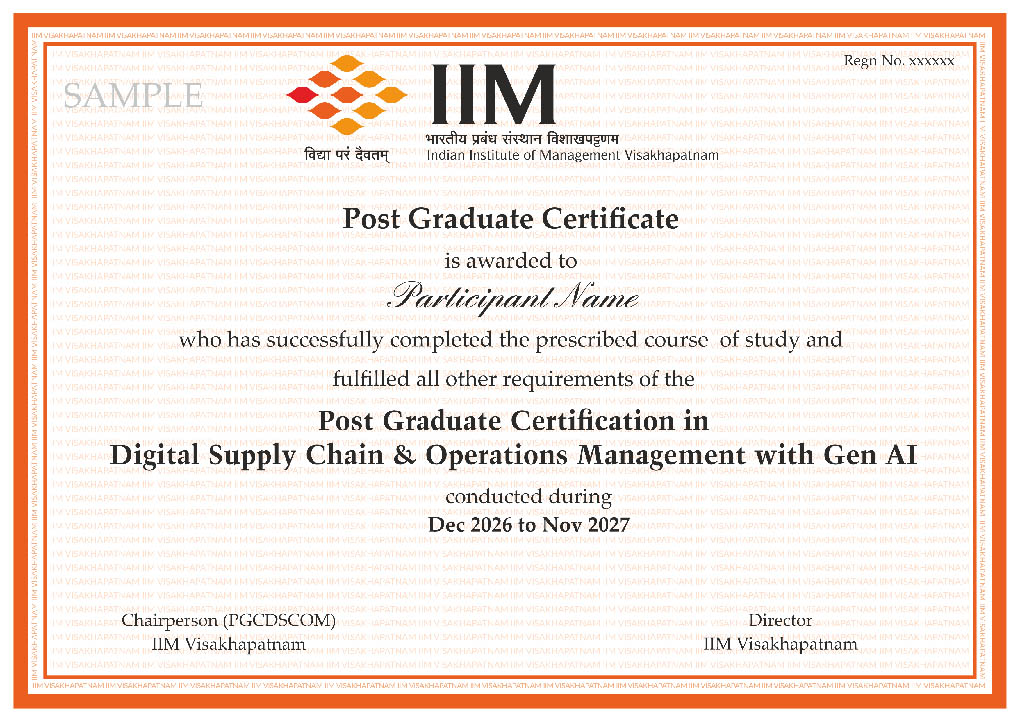
Course Certificate
Earn Certification After The Successful Completion Of The Course
Click to enlarge
Tools to be Used
About the institute
IIM VISAKHAPATNAM
- Having rich knowledge resources; and modern infrastructure, even in its temporary campus, conducive to learning outcomes of high impact.
- Having a vibrant student cohort with national character (representing 22 states) that excels in academics, co- and extra-curricular activities and regularly wins competitions pan-India.
- Recording top placements among 10 IIMs.
- Conducting a customized MBA Program on weekends for experienced professionals.
IIM Visakhapatnam: Leadership in Management Development and Entrepreneurship
Indian Institute of Management Visakhapatnam (IIM Visakhapatnam) belongs to the prestigious IIM family of business schools. It is a new-generation IIM, established by the Government of India in September 2015. The Indian Institutes of Management Act, 2017 declares IIMs as Institutions of National Importance, empowered to attain standards of global excellence in management, management research, and allied areas of knowledge. Continuing its journey of steady progress and growth since its inception, IIM Visakhapatnam has already carved out a niche for itself among the IIMs, crossing several milestones and maintaining a distinct lead in:
• Having rich knowledge resources and modern infrastructure, even at its temporary campus, conducive to high-impact learning outcomes.
• Having a vibrant student cohort with a national character (representing 22 states) that excels in academics, co-curricular and extracurricular activities, and regularly wins competitions across India.
• Recording top placements among the 10 newer IIMs.
• Enjoying excellent linkages with apex industry bodies like CII.
• Having a faculty comprising PhD holders from top-notch institutions in India and abroad, including IIMs, IITs, and reputed foreign universities.
• Hosting the largest cohort of women entrepreneurs after IIM Bangalore (Mentor Institute) under a special initiative called the Women Startup Program.
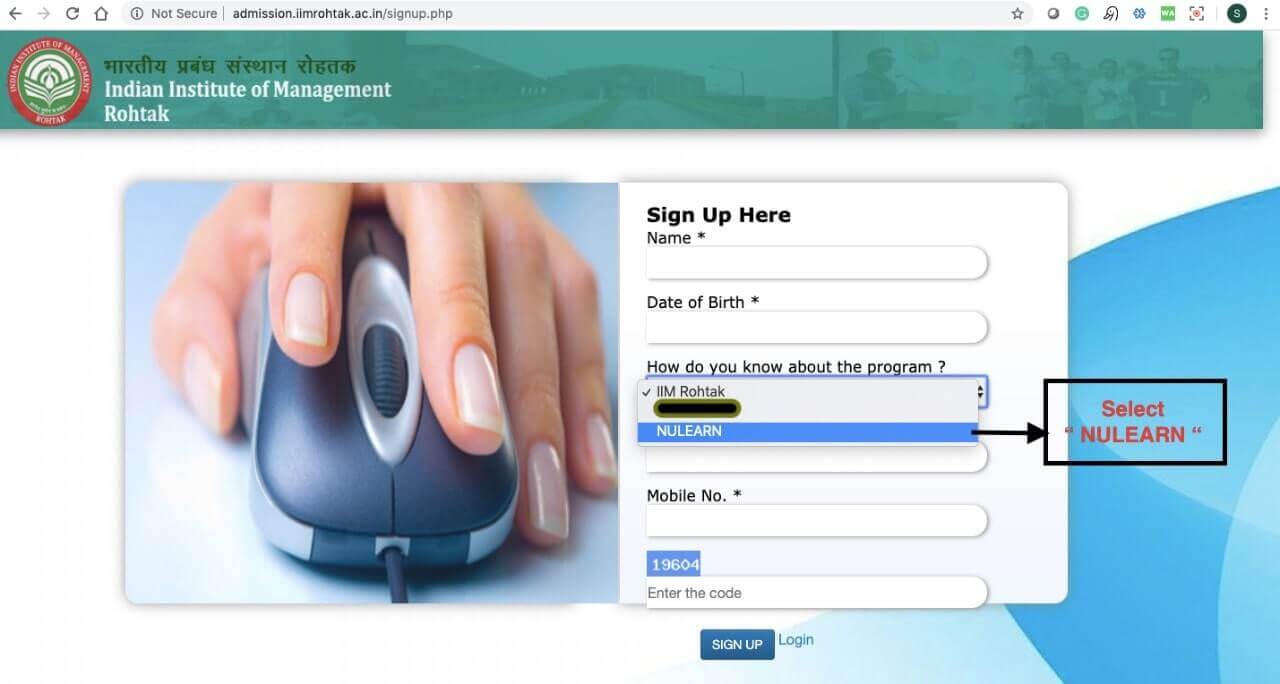
Start Your Application
-
I have read the details and eligibility criteria for admission to the program, that I am applying for.
-
I understand that my application shall be considered complete only when the Application fee along with required documents are received by IIM Rohtak and all mandatory fields in the application form are completed.
-
I understand that merely submitting the application form and fee, does not entitle me for the admission to the Diploma programme The admission is purely on the basis of my profile scoring, qualification and further evaluation by the Institute.
Career Assistance
Corporate Prices / Plans
No. of Nomination
Discount
2 to 5
5%
6 to 10
7.5%
11 to 20
10%
21 and above
Contact the team
EMI Options / Plans
Partner
Tenure
EMI
1
Rs. 157000 + 18% GST
2
Rs. 157000 + 18% GST
9
Rs. Monthly
12
Rs. 10212 Monthly
Please Note
-
Processing Charges may be applicable as per bank rules.
-
No loan facility is available for foreign students.
Register Now
give your career a boost
Relevant Courses
Admission Closed
Executive Certificate Program in Project Management
Certified by
IIM ROHTAK
Duration
5 Months
Admission Closed
Executive Certificate Program in Advanced Supply Chain Management
Certified by
IIM ROHTAK
Duration
5 Months
Admission Open
Executive Development Program in Advanced Project Management
Certified by
IIM KASHIPUR
Duration
6 Months
Coming Soon
eDP in Advanced Supply Chain Management and Analytics - Batch 5
Certified by
IIM KASHIPUR
Duration
6 Months
Coming Soon
Executive Development Programme in Operations Management with Six Sigma
Certified by
IIM KASHIPUR
Duration
5 Months
Coming Soon
Executive Development Program in Operations Management with Six Sigma
Certified by
IIM RAIPUR
Duration
5 Months
Admission Closed
PG Certificate Program in Digital Leadership in Smart Manufacturing
Certified by
IIM VISAKHAPATNAM
Duration
12 Months
Admission Closed
PG Certification in Digital Operations and Smart Supply Chain Strategy
Certified by
IIM VISAKHAPATNAM
Duration
12 Months
Coming Soon
Executive Development Programme in Operations Management with Lean Six Sigma
Certified by
IIM Jammu
Duration
Blended Learning


