



Every company says it has an edge. Very few can pass four questions about it.
Ask a leadership team what makes them better than the competition and you'll hear plenty: our people, our technology, our brand, our relationships. All of it sounds plausible. The harder question is which of those things a rival couldn't copy next year. That is the question the VRIO framework was built to answer, and it sits at the heart of any serious Advanced Strategic Management Course
Understanding the Four Pillars of the VRIO Framework
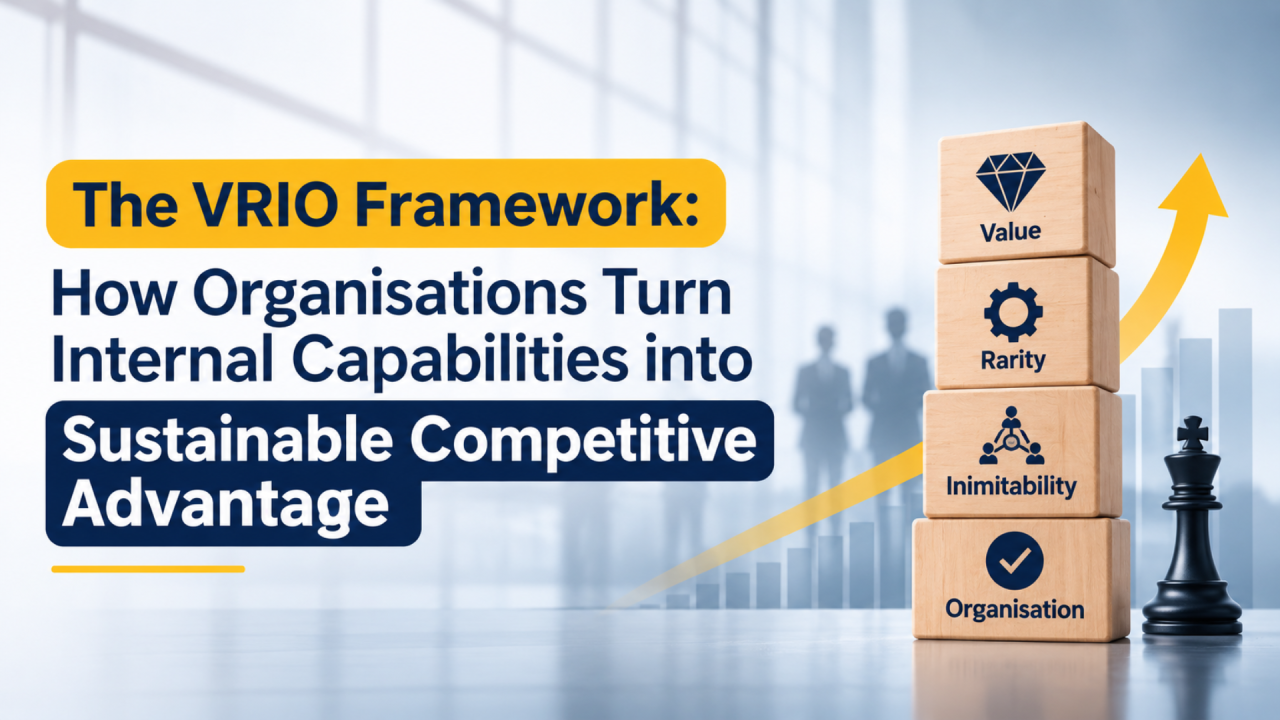
The VRIO framework comprises four elements: Value, Rarity, Imitability and Organisation. Take any resource or capability, such as a patent, a distribution network or a team's know-how, and ask:
- Value: can it be used to help the firm take advantage of an opportunity or minimize a threat? Otherwise, it's simply something you own.
- Rarity: do many competitors already have it? If everyone does, it keeps you in the game but doesn't win it.
- Imitability: how hard or costly would it be for others to copy or replace it? Things with a history, or tangled up in culture, are hard to reproduce.
- Organisation: is the company set up to use it properly, with the right structure, processes and incentives?
A valuable resource that is not scarce, typically generates competitive equilibrium. A valuable and rare, but easily imitated resource may provide a temporary competitive edge. If it is valuable, rare, hard to copy, but not known to those within the organisation, then the advantage will not be realised. If all four are fulfilled, the resource can potentially be used to create a competitive advantage
The framework also keeps leaders honest about timing. A resource that passes today can fail in three years, when a competitor catches up or the market moves, so the exercise is worth repeating whenever the industry shifts.
Amul: A Real Example of a Lasting Advantage
The farmers who supply the milk run the business of Amul . It has three levels: village dairy societies, 18 district milk unions, and a federation that handles marketing and selling. Let’s test it.
- Value: Yes. Brand turnover passed Rs 1 lakh crore in FY2025-26, up 11%. (yourstory)
- Rarity: Partly. The model is no longer rare, because India set up the National Dairy Development Board in 1965 to copy it. What is still rare is the size: Amul was the first Indian FMCG brand to reach Rs 1 lakh crore in brand turnover.
- Imitability: Hard. Anyone can copy the structure on paper. Trust between farmers and management is harder to copy. Private dairies also face a limit: their investors expect a share of profit, and giving most of the consumer’s money to farmers would remove it.
- Organisation: Yes. The village society collects the milk, the union processes it, and the federation markets it. The surplus goes back to farmers, not to shareholders.
Amul’s size is easy to say and hard to take in. For FY2025-26, the brand’s total turnover is estimated at more than ?1 lakh crore, about 11% higher than the year before. GCMMF, the cooperative federation behind it, reported ?73,450 crore on its own.
Sources: National Dairy Development Board; Government of India; FY2025–26 turnover reported by The Economic Times.
Why it matters for Corporate Strategy and Business Growth
Most executives can list their strengths. Fewer can rank them. VRIO forces that ranking, so investment goes to the capabilities that actually set the firm apart, not to the ones that merely feel familiar. That discipline is central to Corporate Strategy and Business Growth, because every decision about expansion, partnerships or acquisitions rests on what the firm can do better than others, and for how long.
Where VRIO fits in XLRI Advanced Strategic Management
XLRI Advanced Strategic Management treats this kind of thinking as a skill managers can practise. The 13-module curriculum includes Organizational Resources and Capabilities, which covers building and using distinctive resources for sustainable advantage, and Value Creation and Competitive Positioning, which looks at cost advantage, differentiation and strategic trade-offs. Around those sit modules on industry dynamics, vertical integration and diversification, mergers and alliances, international expansion, geopolitical resilience, innovation, governance, strategic transformation, digital platforms and AI strategy, and data-driven strategic decision-making. VRIO is a lens you can bring to all of them.
What the programme looks like
The Executive Development Programme in Advanced Strategic Management is a six-month blended programme with weekend online and interactive classes and campus immersion. According to the course page:
- Case-based sessions and industry interaction: the strategy ideas are applied to realistic business situations.
- Live lectures with a 70% attendance requirement: this keeps the learning interactive.
- Assessment: Comprehensive end-course assessment plus a project-based assignment, where you apply the frameworks to a business problem.
- Certificate: Completers receive a certificate of completion from XLRI among its highlights.
A programme for working professionals
This is a Strategic Leadership Programme for Working Professionals, and the page says it is meant for executives in strategic roles, executives whose decisions affect growth or profitability, and younger executives aiming for roles that need strategic thinking. Eligibility is a graduate or diploma holder from a recognised university in any discipline, with at least one year of work experience. That makes the Executive Strategic Management Programme open to people earlier in their careers than many leadership courses.
Turning frameworks into better decisions
A framework only earns its place when it changes a decision. The page stresses using strategy tools in conversations with senior leadership, analysing an industry and a firm's competitive position, and evaluating choices such as growth, diversification, M&A and international expansion. That is the practical side of a Business Strategy and Decision Making Course: you leave able to explain why a capability matters, not just that it does.
For managers who want something to show for it, a Strategic Management Certification from XLRI Jamshedpur adds structure and credibility to that learning, and a Strategic Planning and Management Certification of this kind helps you plan with an eye on what competitors can copy. Confirm the certificate details on the course page, since the wording differs in places.
Build the Strategic Thinking Needed to Lead Business Growth
Next time someone in a meeting says "our people are our competitive advantage", try asking the four questions. If the answers come easily, you're probably ready for bigger strategic decisions. If they don't, that gap is worth closing. An Executive Programme in Business Strategy like this one is one way to do it while you keep working. The full curriculum, eligibility and admission details are on the Nulearn course page.


